
The Business Behind the Brief
Jennyviv is a family-run online boutique based in Independence, Kentucky — selling overstock, boutique finds, and everyday essentials across fashion, home, beauty, kids, and more. By the time this project began, the store had a working WooCommerce setup, a growing product catalogue of 200+ items, and a client who genuinely cared about her business. But the store was not performing. Customers were arriving and leaving. Products were not being found. And the business was quietly losing money on every oversized item it tried to ship.
This was not a case of a client needing a new website. It was a case of an existing system that was not configured to do what the business actually needed. The work began not with design, but with understanding where the gaps were — and there were several.
Phase One: Diagnosing the Shop (February 8, 2026)
What Was Wrong with the Shop Page
The starting point was the shop page. It was a standard WooCommerce archive — functional in the most basic sense, but completely unfit for a store carrying over 200 products across wildly different categories: clothing, bags, home decor, beauty, toys, tools, and more.
There was no filtering. There was no way for a customer to say “show me only women’s clothing under $30 in blue.” There was no way to browse by department, material, size, or style. Every visitor saw the same undifferentiated product grid. For a small catalogue, this might be tolerable. For a 200+ product multi-category store, it was a conversion problem.
Beyond the user experience, the SEO problem was just as serious. Without a proper category hierarchy, without structured product attributes, and without clean taxonomy pages for search engines to crawl, Jennyviv’s shop had almost nothing for Google to index beyond the homepage. Products were invisible in organic search.
Uncovering the Catalogue Problem
Once the shop page was reviewed in detail, a deeper issue became visible: the product data itself was in poor shape. Products were miscategorised or uncategorised. Attributes — size, color, material, department, style, product type — were either missing, inconsistently filled, or not set up in a way that WooCommerce could use for filtering. When this was identified, it was raised with the client directly and she confirmed: the products needed to be fixed before anything else could work properly.
What followed was a full catalogue restructure. Every one of the 200+ products was reviewed individually and corrected:
- Products were assigned to the correct categories within a rebuilt category hierarchy, covering Clothing & Apparel, Bags & Wallets, Home & Decor, Beauty & Haircare, Kids & Toys, Accessories, Seasonal, Tools & Outdoor, and more
- Department assignments were set correctly across Women, Men, Girls, Boys, Teens, Unisex, and Kids
- Product colors were mapped accurately to every item
- Materials were assigned — Polyester, Cotton, Faux Leather, Knit, Canvas, Fleece, and dozens more
- Sizes were standardised and filled across the catalogue
- Style and product type attributes were populated consistently
- Product tags were applied for cross-category discoverability
This was slow, methodical work — but it was the foundation everything else depended on. A filtering system is only as good as the data behind it. Without fixing the catalogue first, no amount of front-end work would have made the shop usable.
Building the Filtering System
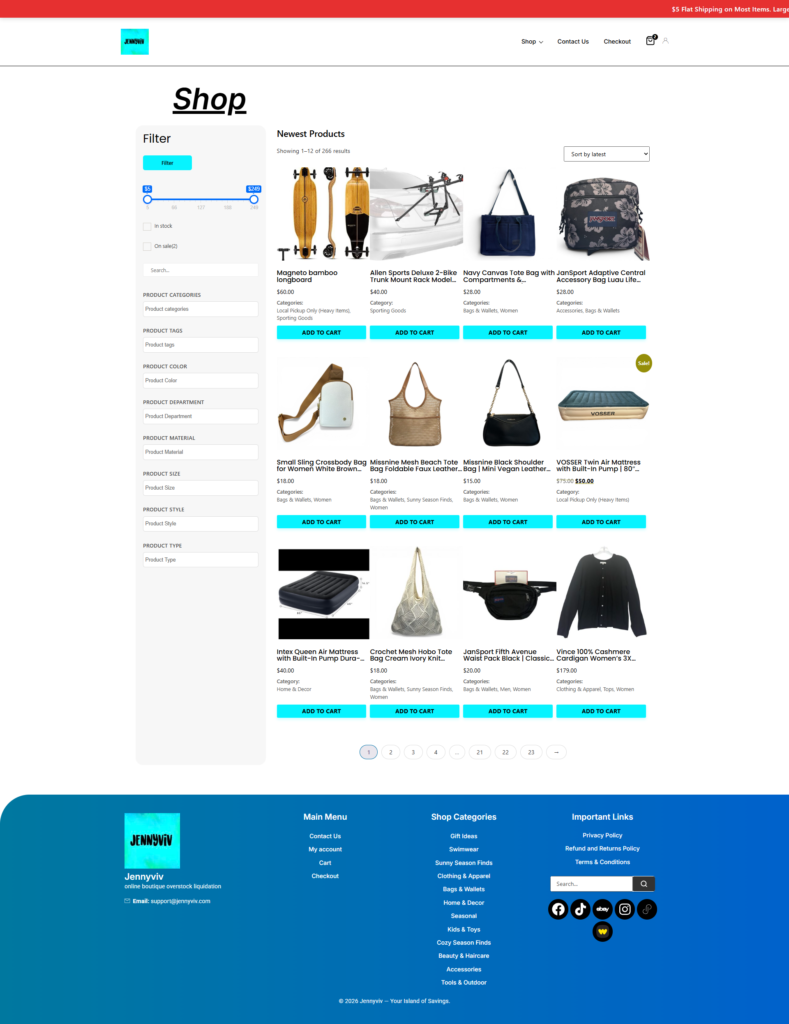
With clean product data in place, the shop page was rebuilt into a fully filterable discovery experience. The goal was to give customers the ability to narrow down exactly what they were looking for — the same way you would in a well-organised physical store — without having to scroll through hundreds of products.
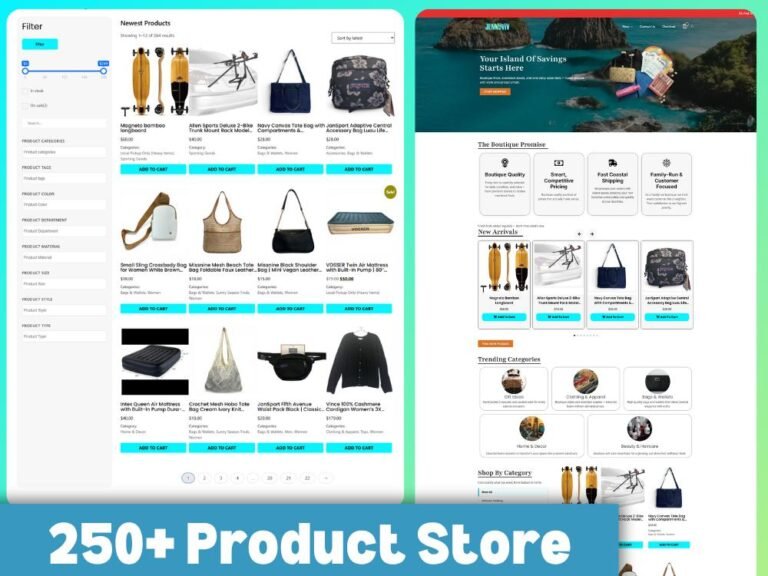
The rebuilt shop now includes the following filters, all working simultaneously with live results:
- Price filter — range-based slider for budget-conscious browsing
- Product category filter — hierarchical categories matching the restructured taxonomy
- Product department filter — Women, Men, Girls, Boys, Teens, Unisex, Kids, and more
- Product color filter — mapped directly to product variants across the catalogue
- Product material filter — fabric and material type for informed purchasing decisions
- Product size filter — standardised sizing across all applicable products
- Product style filter — Casual, Festive, Minimalist, Playful, Modern, Athletic, and more
- Product type filter — Bag, Dress, Top, Tote, Jacket, Ornament, Toy, and dozens of others
- Product tags filter — for cross-category and themed discovery
- Stock status filter — in-stock only toggle to avoid dead ends
- On-sale filter — quick access to discounted items
This transformed the shop from a flat product grid into a structured browsing experience — and gave search engines a properly indexed set of taxonomy and attribute pages to rank in organic results.
Solving the Oversized Shipping Problem
Running in parallel with the shop work was a real operational problem that needed a permanent fix. Jennyviv carries a number of oversized items — larger products that are impractical or unprofitable to ship through standard delivery. Without any logic in place, these products were either causing financial losses at fulfilment or creating confusion for customers at checkout.
A conditional shipping system was built using WooCommerce shipping classes and custom PHP. The logic is automatic — no manual intervention required from the client or the customer:
- Small orders — assigned flat rate economy shipping ($5)
- Standard orders — assigned standard shipping ($10)
- Larger orders — assigned a higher rate to reflect fulfilment cost ($15)
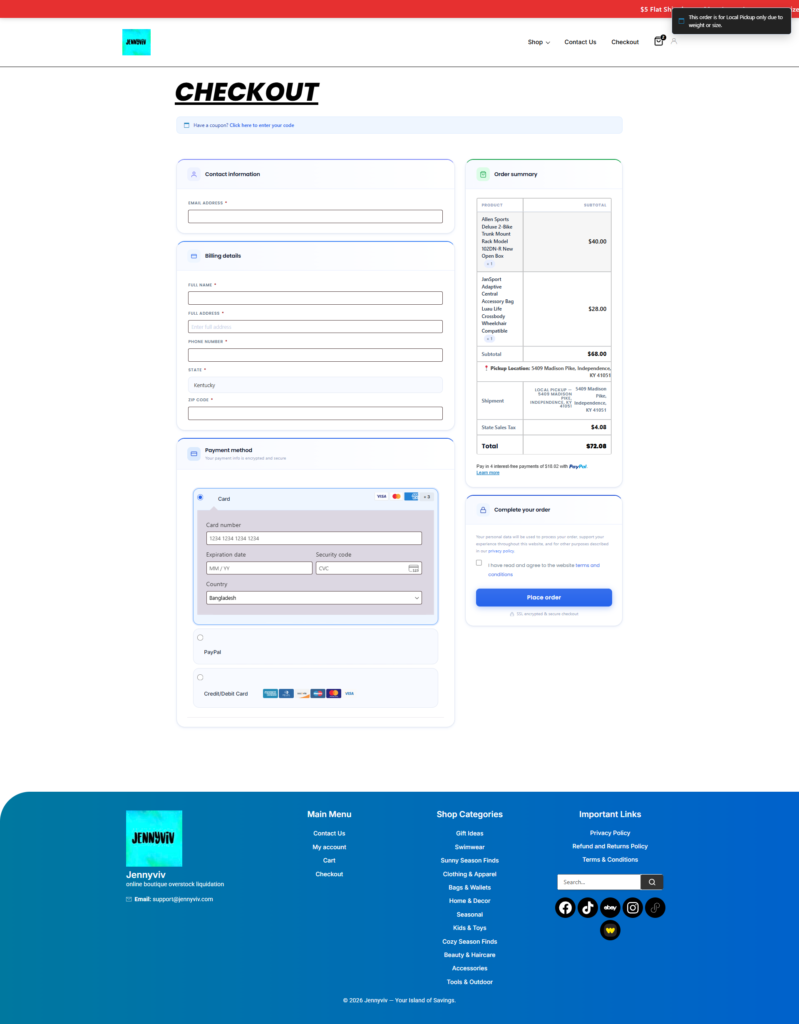
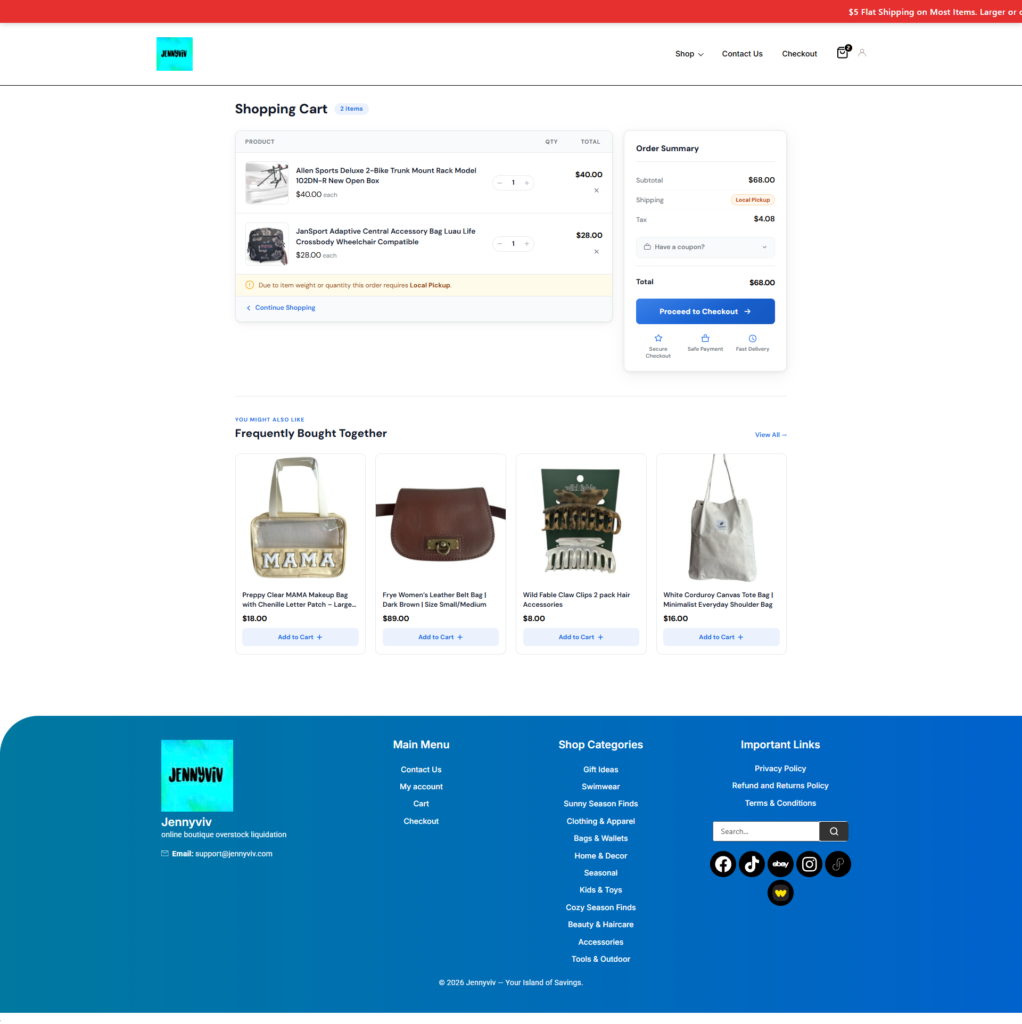
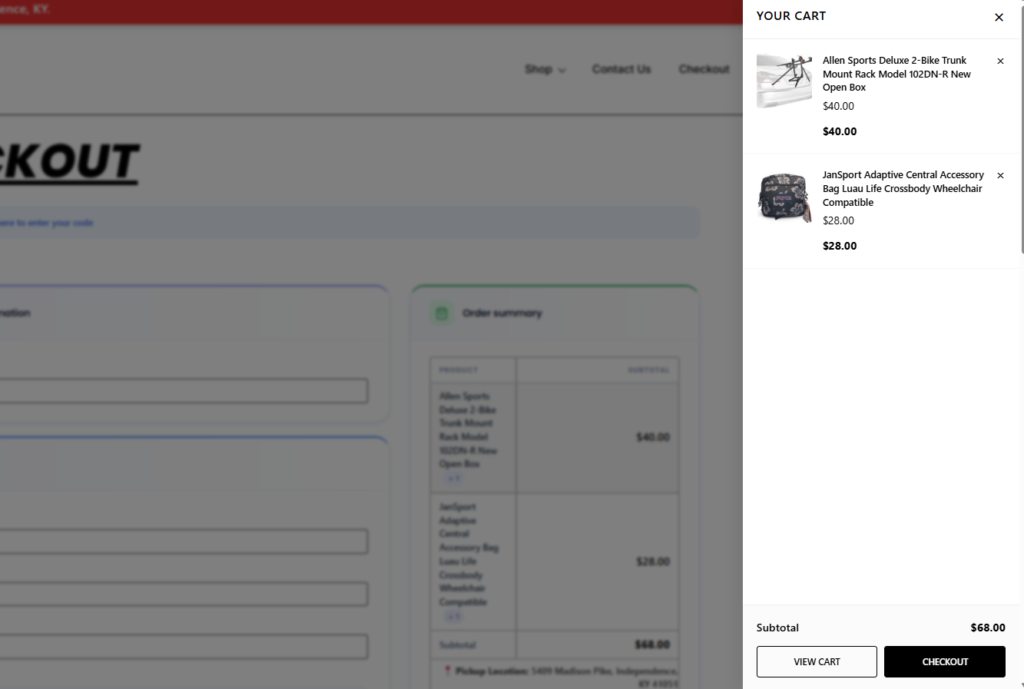
- Any cart containing an oversized item — all shipping options are hidden; the only available option becomes local pickup in Independence, KY, at no charge to the customer
The logic fires silently. If a customer adds an oversized item alongside regular products, checkout automatically restricts to local pickup and presents it clearly — no confusion, no workaround needed. The client stopped absorbing losses on oversized fulfilment, and customers got a clear, honest checkout experience. This is exactly the kind of rule you can see in action on the shop page today — items like large air mattresses are listed as local pickup only, right in the product listing.
Phase Two: Homepage Redesign and Checkout Experience
Redesigning the Homepage
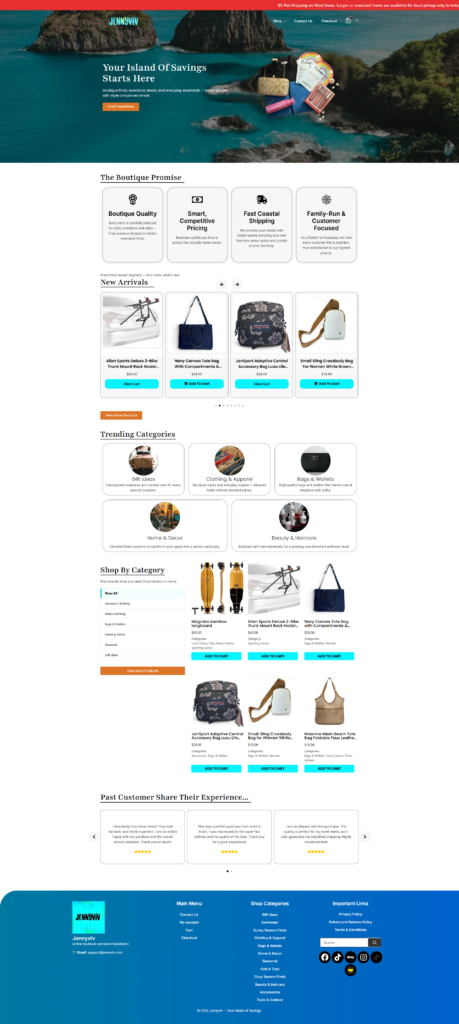
The original homepage was generic — it had no structure, no brand identity, and nothing that communicated what Jennyviv was or why a first-time visitor should trust it or stay. It was a missed opportunity at every level: for brand credibility, for customer orientation, and for SEO.
The homepage was redesigned from scratch using Elementor. The new layout is built to do what a good retail front door should do — orient the visitor, build immediate trust, and guide them toward the right part of the shop without friction. The redesigned homepage now includes:
- Hero section — clear value proposition (“Your Island of Savings Starts Here”) with a direct call to action leading to the shop
- New arrivals section — dynamic product feed surfacing the latest additions for returning visitors
- Trending categories section — visual category blocks linking directly to Gift Ideas, Clothing & Apparel, Bags & Wallets, Home & Decor, and Beauty & Haircare
- Boutique Promise section — communicating the brand’s commitment to quality, smart pricing, fast shipping, and family-run service
- Shop by category section — quick-access category filter for browsing without entering the full shop
- Customer testimonials section — real social proof integrated naturally into the page flow
- SEO-ready structure throughout — proper heading hierarchy, internal links to key category pages, and semantic markup
The result is a homepage that earns trust before the customer ever clicks into the shop — and gives search engines a content-rich, well-structured page to index and serve in results.
The Custom Buy Now Feature
One of the final pieces of work was a custom feature added to every single product page — a Buy Now button that addresses a genuine friction point in the default WooCommerce purchase flow.
The problem: when a customer is browsing and already has items in their cart, and they find something they want to purchase immediately, WooCommerce gives them no clean path. They either go through a full multi-item checkout with everything in the cart, or they manually empty their cart and start again. Neither option is good for impulse purchases or single-product buying decisions.
The custom Buy Now logic works as follows:
- The customer clicks Buy Now on any product page
- Their current cart contents are saved temporarily in the background
- The cart is cleared
- Only the selected product is added to the cart
- The customer is redirected directly to checkout
- After the transaction completes, their previously saved cart items are silently restored
The customer gets a frictionless, single-product checkout experience without losing anything they were still considering. It is a small feature with an outsized impact on conversion — particularly for a store like Jennyviv where customers regularly browse across multiple categories before making a decision.
The Outcome
By the end of both project phases, Jennyviv had been rebuilt at every level that mattered for the business. The shop had structure, filtering, and SEO-ready taxonomy. The product catalogue was clean, correctly attributed, and properly categorised. The shipping system protected the business from oversized fulfilment losses automatically. The homepage converted first-time visitors instead of losing them. And the checkout had a fast-buy path for customers who knew exactly what they wanted.
More than the technical deliverables, this project carried personal weight. The client had been close to walking away from the business entirely. The store was not working, and she was running out of reasons to believe it would. What changed was not just the website — it was the realisation that the business had real potential, and that the right systems could unlock it. By the end, she had sales, she had a functioning store she could be proud of, and she had her confidence back.